Coming Back Again Mountain Goats Lyrics
Facts About Goats
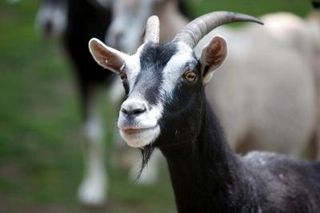
Goats are stout-bodied mammals with horns and cloven hooves. There are two types of goats: domestic goats (Capra hircus), which are raised and bred as farm animals; and mountain goats (Oreamnos americanus), which live in steep, rocky areas in the American Northwest.
Goats are members of the Bovidae family, which also includes antelopes, cattle and sheep, according to the Integrated Taxonomic Information Organization (ITIS). Other members of theCapragenus include the ibex, markhors and turs, which are sometimes called wild goats. Mountain goats are the simply living species in the genusOreamnos.
Size
Mountain goats tin can counterbalance from 125 to 180 lbs. (57 to 82 kilograms) and grow from 49 to 70 inches (124 to 178 centimeters) long. Their black horns grow upwards to 8 to 12 inches (20 to 30 cm) long. They do not shed their horns, and then a goat's age can be determined by counting the annual growth rings. Both males and female person mountain goats have horns, according to the Animal Diversity Web (ADW) at the University of Michigan.
There are most 200 breeds of domestic goat, co-ordinate to the Smithsonian Institution, so sizes vary profoundly. One of the smallest breeds, the Nigerian dwarf caprine animal, weighs about 20 lbs. (9 kg). Pygmy goats weigh from 53 to 86 lbs. (24 to 39 kg). The Anglo-Nubian caprine animal weighs up to 250 lbs. (113 kg).
Habitat
Mountain goats are plant in the Rocky Mountains, typically in Alaska, western Montana, cardinal Idaho, South Dakota, Colorado and Washington. The wide spread of their cloven hooves allows them to climb steep mount sides with ease. They usually live in elevations of iii,281 to 16,404 feet (1,000 to v,000 meters) above sea level.
Domestic goats are raised all over the world in almost every type of terrestrial biomes. The main habitat requirements for a domestic caprine animal are grass to swallow and a clean, ventilated shelter, according to the ADW.
Habits
Goats are very social creatures and live in groups chosen herds, which may incorporate as many as 20 goats in the wild, according to National Geographic. Mount goats are well-nigh social during the wintertime and tend to go solo in the summer. In herds, there is a ascendant female throughout the twelvemonth, until mating season. At this time a male dominates the herd. Many times, males but live with a few other males or by themselves, year-round.
Goats typically spend their days grazing on grasses within their dwelling range, which is an area of nearly 14 square miles (23 square kilometers), co-ordinate to the ADW. Mountain goats will dig 1 to 1 inch (25 to 50 mm) depressions in the ground to sleep, rest and dust bathe in.
Diet
Goats are herbivores, which means they eat just vegetation. Their favorite nutrient is grass, though mount goats also swallow mosses and plants. Many domestic goats will also consume trash, business firm plants or whatsoever other items they find lying around.
Goats catch nutrient with their lips and bring it into their mouths, co-ordinate to the Smithsonian. The upper jaw is wider than the lower jaw, and so they can only employ one side of their mouths to grind the food. This causes the rotary motility that is seen when a goat (or a cow) is chewing.
Goats are ruminants, and like cattle, they accept four stomach compartments. The rumen can hold 4 to 6 gallons (fifteen to 23 liters); the reticulum can hold up to 0.26 to 0.v gallons (0.98 to 1.nine liters); the omasum can agree upwards to 0.26 gallons (0.98 liters) and the abomasum can hold up to 1 gallon (three.eight liters). Information technology takes xi to xv hours for food to pass through a caprine animal'due south digestive organisation.
Offspring
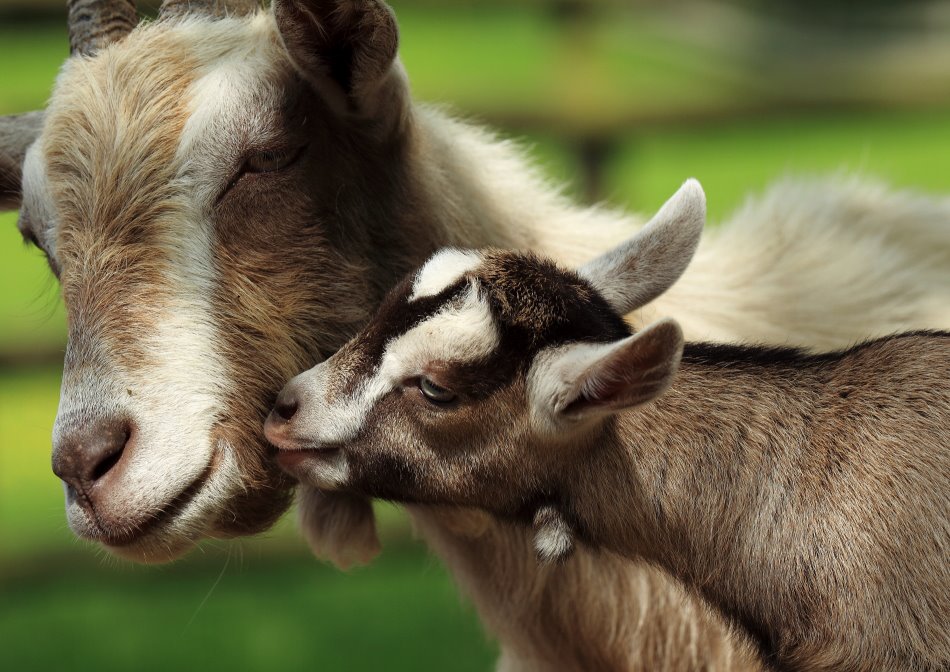
A male goat is called a buck or a billy, unless it is castrated, then information technology is called a wether. Female goats, also called nannies or does, requite nascence to ane or ii offspring in the leap after a gestation period of 150 to 180 days. Babe goats are called kids.
Within minutes of being born, kids are upwards and walking around. At three to 4 months the kids are weaned, and at 30 months they are set to take kids of their own. Wild goats typically take a life span of ix to 12 years.
Classification/taxonomy
Here is the taxonomy of goats, according to ITIS:
Kingdom: Animalia Subkingdom: Bilateria Infrakingdom: Deuterostomia Phylum: Chordata Subphylum: Vertebrata Infraphylum: Gnathostomata Superclass: Tetrapoda Course: Mammalia Bracket: Theria Infraclass: Eutheria Order: Artiodactyla Family: Bovidae Subfamily: Caprinae Genera & species:
- Oreamnos americanus(mountain goats)
- Capra hircus (domestic goats)
Subspecies:
- Capra hircus aegagrus (bezoars, or wild goat), found in southwest asia
- Capra hircus chialtanensis (Chiltan goat), found in west-central Pakistan
- Capra hircus cretica (Cretan caprine animal, kri-kri, agrimi, or Cretan ibex), constitute in eastern Mediterranean
- Capra hircus hircus
- Capra hircus jourensis
- Capra hircus picta
Conservation status
According to the International Union for Conservation of Nature (IUCN), near wild goats are considered vulnerable, threatened or endangered. For example, the Capra hircus aegagrus is considered vulnerable because of an estimated population decline of effectually thirty pct over the past three generations.
A cousin of the goat, Capra caucasica, or West Caucasian tur, a mountain-home goat-antelope found just in the Caucasus mountains, is considered endangered past the IUCN considering of an estimated population decline of more than than 50 percent over the by 3 generations.
Goats vs. sheep
Goats and sheep are different species, and in that location are several physical and behavioral differences. According to Susan Schoenian, a sheep and goat specialist at the University of Maryland, on the website Sheep101:
- Goats have 60 chromosomes; sheep have 54. (Humans take 46 chromosomes.)
- A goat's tail unremarkably points up (unless it is frightened or sick); a sheep's tail hangs downwards and is often shortened (docked).
- Goats are independent and naturally curious; sheep prefer to flock together and are more aloof.
- Goats' coats exercise not require shearing or combing (but Angora goats are sheared to provide a fiber called mohair). A sheep'south woolly glaze will continue growing unless information technology is sheared. [Related: Overgrown Sheep Gets Record-Breaking Haircut]
- Well-nigh goats accept horns; many breeds of sheep are hornless (polled). Goat horns are narrow and straight; sheep horns curl effectually in loops on the side of their heads.
Other facts
- Mount goats can leap 12 feet (3.5 meters) in a single bound, according to National Geographic.
- Mount goats have bright white coats that assistance them blend into the snowy areas of their home ranges. Domestic goats accept coats that are yellow, chocolate or blackness.
- Goats were ane of the outset domesticated animals and were first domesticated around nine,000 years ago, according to the Smithsonian.
- In bright light, the pupil in a goat's middle is rectangular rather than circular.
- Goat meat — called chevon or cabrito — is eaten all over the globe.
- More than people eat caprine animal milk than the milk from any other animal.
Additional resources
- San Diego Zoo: Domestic Goats
- The Guardian: Synthetic Biology and The Ascent of the 'Spider-Goats'
- Oklahoma State University: Goat Breeds

Alina Bradford is a contributing writer for Alive Science. Over the past xvi years, Alina has covered everything from Ebola to androids while writing wellness, scientific discipline and tech articles for major publications. She has multiple wellness, safety and lifesaving certifications from Oklahoma State University. Alina's goal in life is to endeavour as many experiences every bit possible. To date, she has been a volunteer firefighter, a dispatcher, substitute teacher, creative person, janitor, children'due south book author, pizza maker, result coordinator and much more.
Source: https://www.livescience.com/52540-goat-facts.html
0 Response to "Coming Back Again Mountain Goats Lyrics"
Enregistrer un commentaire